
Lançamento do NitroGen: Um Modelo de Fundamento Open-Source para Agentes de Jogo Generalistas
Lançamento do NitroGen: Um Modelo de Fundamento Open-Source para Agentes de Jogo Generalistas
aitech.pt
aitech.pt
Nvidia Releases NitroGen: An Open-Source Foundation Model for Generalist Gaming Agents
Artificial Intelligence (AI) in gaming has evolved dramatically, with 70% of gamers expressing interest in AI-driven characters that enhance their gameplay experience. In this exciting context, Nvidia, in collaboration with renowned researchers from institutions like Stanford and Caltech, has launched NitroGen, a groundbreaking open-source foundation model designed for generalist gaming agents. This model marks a significant advancement in how AIs interact with games, and it is engineered to operate across diverse platforms and genres. In this article, we will delve into the characteristics, performance, and future implications of NitroGen within the AI gaming landscape.
Innovative Training and Extensive Data
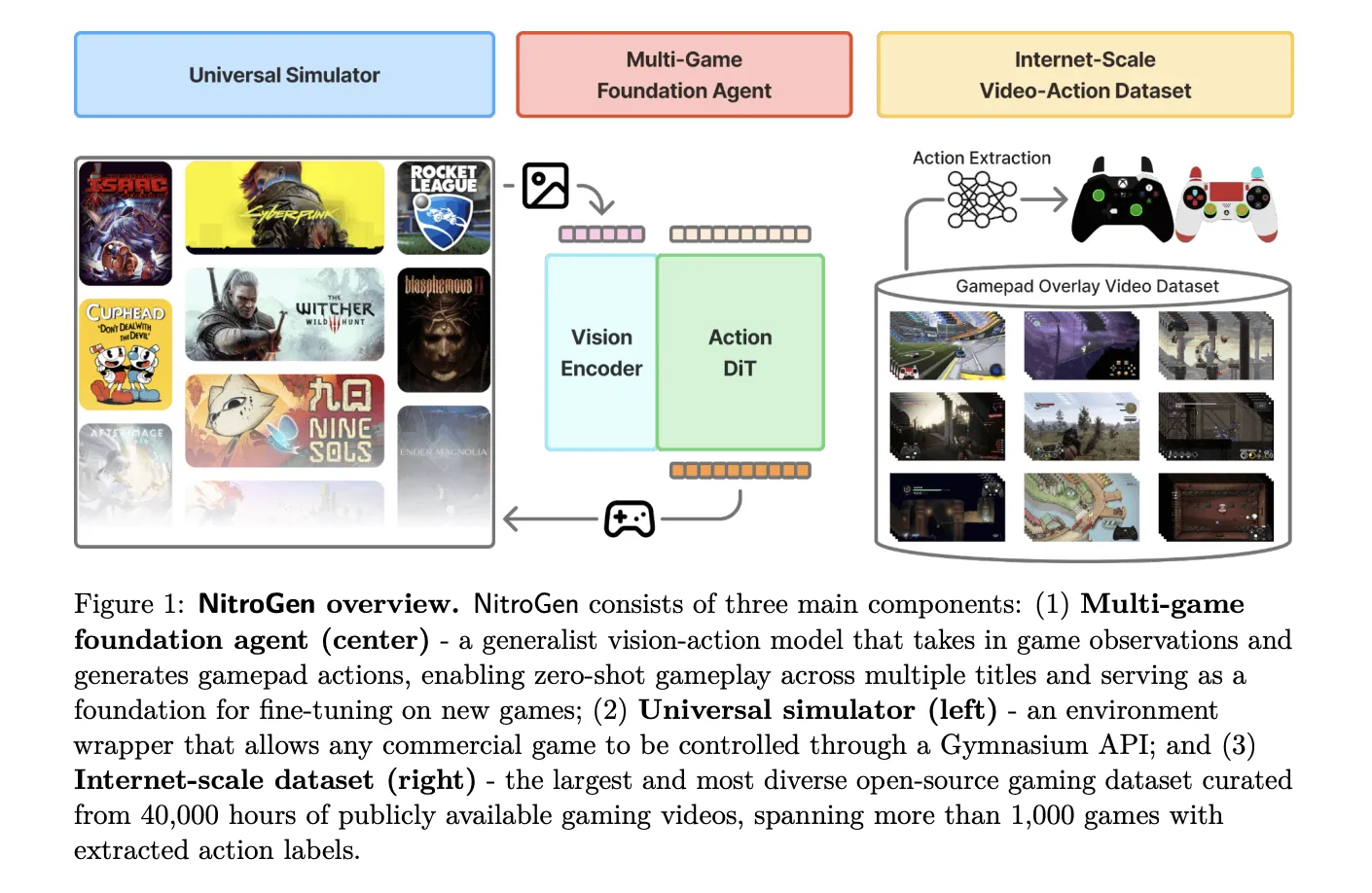
NitroGen has been trained on an impressive 40,000 hours of video game recordings from over 1,000 different games. What sets this approach apart is the use of often-overlooked data sources: videos from YouTube and Twitch showcasing game controller overlays. This innovative technique enabled the extraction of in-game actions through template matching and an adjusted SegFormer model.
Model Architecture

NitroGen is based on Nvidia’s GROOT N1.5 robotics architecture, tailored specifically for the gaming context. This model can process game frames in raw RGB format and utilizes a behavior cloning mechanism to generate controller actions from a noisy internet dataset. Importantly, this method does not require internal game states or custom rules, making it highly scalable and applicable across various titles.

Performance Across Various Genres
NitroGen underwent rigorous testing across an array of game genres, including RPGs, platformers, battle royales, racing games, and both 2D and 3D environments. The results showcased robust performance in:
- Combat scenarios
- Precision control
- Exploration tasks
Moreover, the model displayed remarkable effectiveness even in procedurally generated games or those previously unseen. In comparative evaluations, NitroGen achieved up to a 52% relative improvement in task success rates compared to models trained from scratch. This impressive performance was realized using a single 500 million parameter model, without necessitating fine-tuning.
Open Resources for the Community
One of the most significant aspects of NitroGen’s release is the availability of all resources to the public, including:
- The dataset
- Model weights
- Source code
- Evaluation suite
- Research paper
By making this information accessible, Nvidia supports further advancements in areas such as video games, robotics, and embedded AI. Interested parties can access the official site at nitrogen.minedojo.org or check the repository on GitHub at github.com/MineDojo/NitroGen.
Future Implications
The emergence of universal agents like NitroGen not only redefines the capabilities of AI in gaming but also has significant implications for robotics development. The transition of techniques learned in gaming environments to real-world applications could enhance our interactions with technology in the future.
“NitroGen demonstrates the potential for a robust and versatile AI capable of adapting across multiple contexts.” — Nvidia
Foreseen Challenges
While NitroGen showcases significant advances, it also faces several challenges:
- Complex Context Interpretation: In more intricate games, the AI may struggle to interpret dynamic states.
- Security and Ethical Considerations: The deployment of open models raises concerns regarding potential misuse.
- Compatibility: Ensuring the AI operates effectively across all genres and platforms requires continuous effort.
These factors will be crucial in the adoption and development of future AI agents in gaming.
Conclusion
Nvidia’s NitroGen represents a significant milestone at the intersection of gaming and artificial intelligence. With its innovative approach and extensive dataset, the model not only enhances task success rates in gaming but also paves the way for future research across various AI applications. This initiative highlights the importance of sharing knowledge and resources within the research community, enabling developers and researchers to fully leverage these new tools.
Call to Action
As AI in gaming continues to evolve, we encourage you to explore NitroGen’s capabilities further and consider how open-source models like this one could shape the future of gaming and beyond.
Sources
Share this post
Like this post? Share it with your friends!